The system isn't going to smash itself!
One of my favorite political cartoonists, Stephanie McMillan, whose cartoons I read via a Comics.com email feed just published two strips about Bunnista vs. the Chainsaw factory that cracked me up.
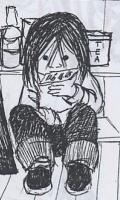
One of my favorite political cartoonists, Stephanie McMillan, whose cartoons I read via a Comics.com email feed just published two strips about Bunnista vs. the Chainsaw factory that cracked me up.
Library of Congress Subject Headings Weekly List 18 (April 30, 2008) and List 19 (May 7, 2008)
PLURALISM is dead in favor of MULTICULTURALISM and other cross references. And FIRST WAVE FEMINISM gets acquainted with SUFFRAGE.
I'm trying to catalog the zine, "I'm fat. You're fat. We're Fat! A collaborative zine project." It's a fat power zine, but sadly there's no subject heading for that. I looked in the Library of Congress catalog to see how they treated similar themed content and came up with OBESITY, which I'd say misses the point for I'm Fat, especially given the name of the conference for which the zine was created, Fat is Contagious: Political Fat Queer Visibility and Action in the Age of the "Obesity Epidemic."
A while ago Anastasia Diamond-Ortiz of the Cleveland Public Library wrote on the Zine Librarians Yahoo Group, "Blogs are immediate, zines are deliberate." And here I am blogging an event that happened three weeks ago now. I think I'm missing the point! Therefore, I'm going to wrap up my GLBT ALMS recap now or never! (And theoretically my next zine will be deliberate, rather than hastily thrown together, poorly proofread, and with weak, nonsensical graphics.)
So, following is my report back on the zine libraries discussion and Alana Kumbier & Christa Orth's Archiving from the Ground Up
I hate hate hate the winter and never feel like leaving the house. Then along comes May and all of a sudden there are a million things I want to do outside of the comfort of my own (or Eric's) home.
Since this doesn't seem to have much of a web presence, I thought I'd blog it, albeit a little late to do much good.
Ping Pong Tournament!
Sat. May 24 at 7PM
6th St. Community Center btwn B & C
Day Two of the GLBT ALMS conference at the CUNY Grad Center.
Susan Stryker talked about how history can be
She was most interested in the last interpretation, and discussed it mostly through the lens of the GLBT Historical Society in San Francisco, which she directed for five years after being a regular researcher and volunteer there.
Day Two of the GLBT ALMS conference at the CUNY Grad Center. Less Process/Less Privacy: Implications of Minimal Processing for GLBT Collections with Jodi Berkowitz, Laura Micham, Heather Murray, and Minnie Bruce Pratt.
NOSI, the Nonprofit Open Source Initiative is hosting a training, or really an "untraining," meaning the event's program will be devised at the beginning of the day, based on the attendees' preferences, on using OpenOffice, the open source rival of MS Office. (I wonder if there will be any discussion of the Mac version, NeoOffice.) The event will be held at Google's NYC offices, so there may be some talk about Google docs and the like, as well.
June 5th, 2008 9:00 AM-5:00 PM, 76 9th Avenue. Register.
GLBT ALMS Conference 2008: Coming to Terms
Day One of the GLBT ALMS conference at the CUNY Grad Center. Coming to Terms: LGBTIQ Thesauri, Folksonomies, and Taxononomies with KR Roberto, Ellen Greenblatt, Michael Waldman, and Analisa Ornelas. And the same bad mannered know-it-all from the previous session.