
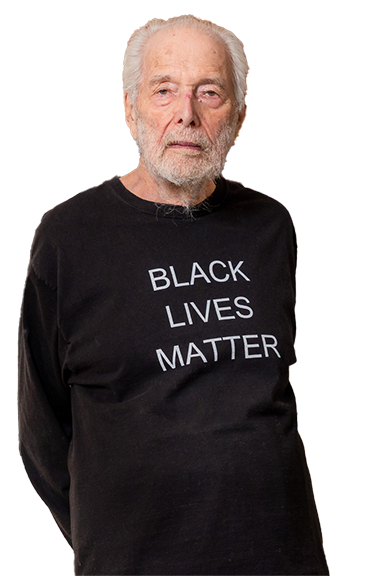
I was invited by an American Libraries editor to interview critical cataloger and general mensch Sanford (Sandy) Berman for its 150th anniversary celebration. The editor shared a comp interview of Brewster Kahle. After a bit of back and forth about interviewing white guys and begging for a chance to interview WeHere founder Jennifer Ferretti (why doesn't Jenny have a Wikipedia entry? why doesn't WeHere?), I agreed to interview Sandy. Sandy, who recently turned 92, decided he wanted to do the interview his way and sent me the typewritten self-interview (shared below), which was determined by AL to be far beyond the interview they scoped and therefore not accepted. I asked Sandy if he'd like me to publish the interview here, and he said that he would!
Q: Should ALA really be celebrating its 150th anniversary?
A: No. Instead, it should be devoting its energy and resources to atoning for its checkered history (e,g., its abject failure to combat segregated libraries and professional associations as well as production of the appallingly racist film The Speaker) and to opposing the current tidal wave of fascism in this country, involving blatant federal and local censorship, limiting access to vital information, suppressing political speech, and outright persecution and dehumanization of immigrants, transgender people, and communities of color.
Q: What sort of activities should ALA be undertaking?
A: Defiance. Resistance. It should vigorously publicizing and supporting actions by librarians and others to oppose or undermine efforts to abridge free expression and research (e.g. defunding studies on atrocities committed at Indian Boarding Schools; removing or altering "woke" or "anti-American" signage, data, leaflets, and books from government websites, libraries, national parks, and schools; stopping the collection and analysis of statistics on hunger).
I addressed some of these concerns in an August 31st, 2o25 letter to the current ALA president:
Dear President,
I confess to being a neo-Luddite and not owning a computer. Hence, I don't have direct access to online ALA news and reports. And I haven't yet received the latest print American Libraries, which may well contain details about the 2025 Annual Conference. I have, however, left phone messages or sent notes to various ALA staffers and units (e.g., the Office for Intellectual Freedom), requesting hardcopies of any statements or resolutions that ALA might have approved lately concerning the Gaza Genocide and Scholasticide, as well as growing federal acts of censorship (e.g., purging "woke" or "un-American" materials and signage from national Parks and elsewhere.
I have received no response to any of these queries. So I don't know what-the-hell my professional organization has done to address these issues.
I believe that ALA should follow the earlier anti-Apartheid playbook and not only condemn the ongoing genocide (which is being largely underwritten by the United States), but also immediately divest from any business that contribute to or profit from the current ethnic cleansing and Apartheid state. Further, ALA should denounce the palpable First Amendment violations represented by the many state bans on advocacy for the BDS (Boycott, Divestment, and Sanctions) movement, urging their repeal.
Regarding federal censorship: ALA should (if it hasn't already) demand the restoration of withdrawn or erased materials and data from federal websites and venues. In addition, it should encourage librarians and others to refuse to cooperate with efforts to pollute, Stalinize, or remove information for blatantly censorious, Orwellian reasons.
With thanks in advance for your attention to these grave matters.
Sanford Berman
ALA Honorary Member
As of 10-8-25, I have received no reply or even acknowledgment.
Q: Does the Library of Congress replacement of MEXICO, GULF OF and DENALI, Mount (ALASKA) as subject terms following a Trumpian decree represent a case of abrogation of professional judgment and autonomy?
A: Yes. I sent this "Letter to the Editor" of American Libraries on March 13, 2025
Dear Colleagues,
With virtually unprecedented speed, the Library of Congress--in a clear act of "anticipatory obedience"--has replaced the primary subject headings, DENALI, MOUNT (ALASKA) and MEXICO, GULF OF. Ditto for both forms as subdivisions.
Earlier, I had expressed the hope that LC would resist the temptation to implement this palpably gratuitous, arbitrary, and baseless game-changing. That admonition appears to have gone unheeded.
Dur President has no authority to wantonly replace the name for international waters that abut more countries than our own. Beyond that, the Gulf of Mexico has been so known since about the 16th century. Its renaming, totally rejected by neighboring Mexico,
smacks of arrogant linguistic imperialism.It seems the whole state of Alaska prefers the Athabascam place-name, Denali, to McKinley, a U.S. President associated with American expansionism who never set foot in Alaska. The widely-unwanted name-change is an affront to Alaska's indigenous population, as well as to its state legislature and two Republican senators.
Although LC has now fully demonstrated its lock-step deference to chauvinistic, ethnocentric, and unjustified authority, I trust American librarians will muster the moral and intellectual strength to ignore its dismal example.
All that LC needed to do as a reaction to Trump's executive order was to introduce the "McKinley" and "America" forms as see-references to the original rubrics. That's all any library needs to do. (Unfortunately, no library schools apparently include a curricular unit on "Denying Wrongful Authority.")
The missive has not been published. But the situation nicely illustrates how local librarians, defying LC's bad precedent, can resist fascist dictates. They can just refuse to implement the LC substitutions (of course, adding the Trumpian variations to both authority records as "see" references). Having mentioned national parks earlier, the demand to flag impure and un-American content can similarly be torpedoed by park staff simply reporting to superiors that no such material could be found.
Q: Gaza came up prominently in your letter to the ALA President. Why is this a library issue?
A: I think this AL communication, dated 10-29-24 answers the question:
Dear Editor,
Libraries are supposed to contribute importantly to an informed citizenry and electorate. That surely includes alerting the public to current issues by means of proactive materials selection, programs, resource guides, and displays.
It has been more than 12 months since a genocide began in Gaza, clearly calculated to reduce, expel, and otherwise eliminate the indigenous Palestinian population and its culture. This particular issue is of greater than usual import for Americans inasmuch as the United States is bankrolling and supplying the perpetrator: Israel. Americans need to know how this crisis arose and what might be done to end it.
I'm only aware of a single reference to the Gaza Genocide in American Libraries: a squib reporting on damage to libraries, framed as essentially "collateral damage," one of the ravages of war. Yet the destruction of libraries, schools, archives, and all 12 of the universities in Gaza has been deliberate, a way to erase Palestinian history and society. I made this point in a brief "letter to the editor, " which has not been published. In the meantime, the latest AL devoted many pages to a long-ago book theft, amusing but hardly helpful in educating librarians and library patrons about truly weighty, literally life-and-death issues like Gaza. Those pages could have been more responsibly and practically devoted to relevant resource lists on topics like anti-Arabism (incidentally, still not an LC subject heading), settler-colonialism, Zionism, anti-Zionism, and Israeli Apartheid. Also useful: reportage from Gaza and the West Bank by on-the-spot journalists and librarians concerning the information scene there. I have suggested people to contact and possible biblio-sources to reprint. No answer. Nothing.
As a profession ostensibly committed to intellectual freedom and diverse opinions, we don't seem to be doing well on this one.
Hoping for more--and quickly,
Sanford Berman
ALA Honorary Member[also included his contact info and a CC list]
So, I've urged AL to run resource lists on Palestine and report on the wholesale devastation of libraries and educational institutions ("scholasticide") in Israeli-occupied territories. Nothing. No response. And in January, 2024, I proposed that the Library of Congress establish a heading for
GAZA GENOCIDE, 2023- . Still waiting. (There also appear to be no rubrics for PALESTINIAN NAKBA, 1967- or BOYCOTT, DIVESTMENT, AND SANCTIONS MOVEMENT.)
Q: Any last words?
A: Absolutely. Rather than commemorating a somewhat tarnished and embarrassing past, there is much to do now in the hallowed halls of librarianship. SO DO IT!
If you're curious, here's what I initially sent to Sandy:
I’m thinking maybe I’ll introduce you as an Honorary Member of ALA. I was able to find the nomination materials, so I can use quotations from that packet. I don’t yet have a sequence for the following questions. I’m sharing them more or less in the order they came out of my pen. Please feel welcome to indicate which appeal and don’t appeal and to edit them. But also, don’t feel obligated to do editorial work, if you understand the distinction. I’m being paid 150 American dollars for my labor. You can approve or veto, or if you wish to help shape the interview, you’re welcome to do that, too. I’ll even share the spoils! Or donate them to whomever you designate.
- I want to focus this interview on what your accomplishments gave you a platform to do, rather than those accomplishments, which I invite people to read about in Wikipedia,the announcement of your Honorary Membership, or in the Festschrift Everything you always wanted to know about Sandy Berman but were afraid to ask.
- On the 150th Anniversary of the American Library Association’s founding, what do you think library workers should be focusing on?
- Who would you include in a list of interviewees, and why?
- You retired earlier than you would have otherwise because you were to have been demoted for your criticism of cataloging policy at your former employer. In an article at the time by John Berry, your departure was characterized as a refusal to kowtow. Many contemporary librarians are facing similar decisions: compromise their values (for example, by removing language about diversity, equity, and inclusion from their library websites, policies, and discovery materials) or lose their jobs. Have you ever regretted your decision to leave, rather than accept the conditions presented to you?
- What would you say to contemporary librarians in positions I described above, who are not close to retirement and have financial or other reasons that they do not feel that they can make the same choice you did?
- Do you think it is possible for library (and elected for that matter) leaders to leverage power while simultaneously compromising their personal views?
- Activist, humanitarian, and comedian (in that order, according to the documentary series Right to Offend: The Black Comedy Revolution) Dick Gregory, at the height of his success, when he was earning $5000/performance (in 1960s dollars!), chose to risk his career to be part of the civil rights movement. What do you think holds library workers back from doing the same? Especially successful, white library workers? (Since we’re both white and the profession is largely white)?
- Can you speak to how “fiduciary responsibility” seems to be a mission statement override for library organizations, in particular when it comes to defending racial equity and…blob forbid, speaking out against genocide in Gaza?
- Would you having stayed at HCL under the conditions laid out for you by then director Charles Brown have benefited your staff or the cause of just catalog descriptions in any way?
- Does the Zapatista maxim that it’s better to die on your feet than live on your knees apply when you’re the head of an organization and have responsibility for other people’s livelihoods?
- What would you like ALA to be focused on for its anniversary?
- You turned 92 this year—mazel tov! You are impressively deft at keeping up with generational norms as they evolve. Do you have advice for other folks on how you avoid being overly attached to the values and mores you were raised with?
- Is there anything you’d like to end on? Perhaps something that rhymes with “schmee schmalestine”?
These are the questions I’m thinking of, but this can just be an opening if you don’t like where I’m headed!